Top 5 Canadian Student Visa Requirements You Must Know Before Applying
Canada continues to shine as one of the world’s most sought-after study destinations—offering world-class education, career-building opportunities, and a safe, multicultural environment where students from across the globe feel at home. Every year, thousands of students choose Canada, and the first big step to making that dream a reality is securing a study permit.
A Canada Student Visa—officially called a Study Permit—is a document issued by the Government of Canada that allows foreign nationals to study at Designated Learning Institutions (DLIs) in Canada.
It’s not the same as a regular visa. A study permit is your permission to study in Canada, while in most cases, you’ll also receive a visitor visa or electronic travel authorization (eTA) along with it, which lets you enter the country.
Key Points About the Canada Student Visa (Study Permit):
- Purpose – Grants international students legal permission to pursue education in Canada.
- Eligibility – You must have an acceptance letter from a DLI, proof of funds, and meet health/security requirements.
- Duration – It is usually valid for the length of your program plus 90 days, allowing you time to prepare to leave or extend your stay.
- Work Opportunities – With a study permit, most students can work up to 24 hours per week during academic sessions and full-time during scheduled breaks.
- Post-Graduation Pathway – After completing studies, students may qualify for a Post-Graduation Work Permit (PGWP), which can be a step toward permanent residency in Canada.
When to apply for a student visa in Canada?
You should apply for a Canadian student visa (study permit) as soon as you get your Letter of Acceptance (LOA) from a Designated Learning Institution (DLI).
✅ Best time to apply:
- 3–6 months before your classes begin.
This gives you enough time for visa processing, biometrics, medical exams, and travel arrangements.
✅ Why apply early?
- Visa processing can take several weeks to months.
- IRCC may request extra documents, which could delay approval.
- You’ll have peace of mind to arrange housing, flights, and orientation.
But here’s the truth: missing even one requirement can lead to long delays or, worse, a refusal. To save you the stress, we’ve broken down the Top 5 Student Visa Requirements you need to know before applying for 2025, which are as follows:-
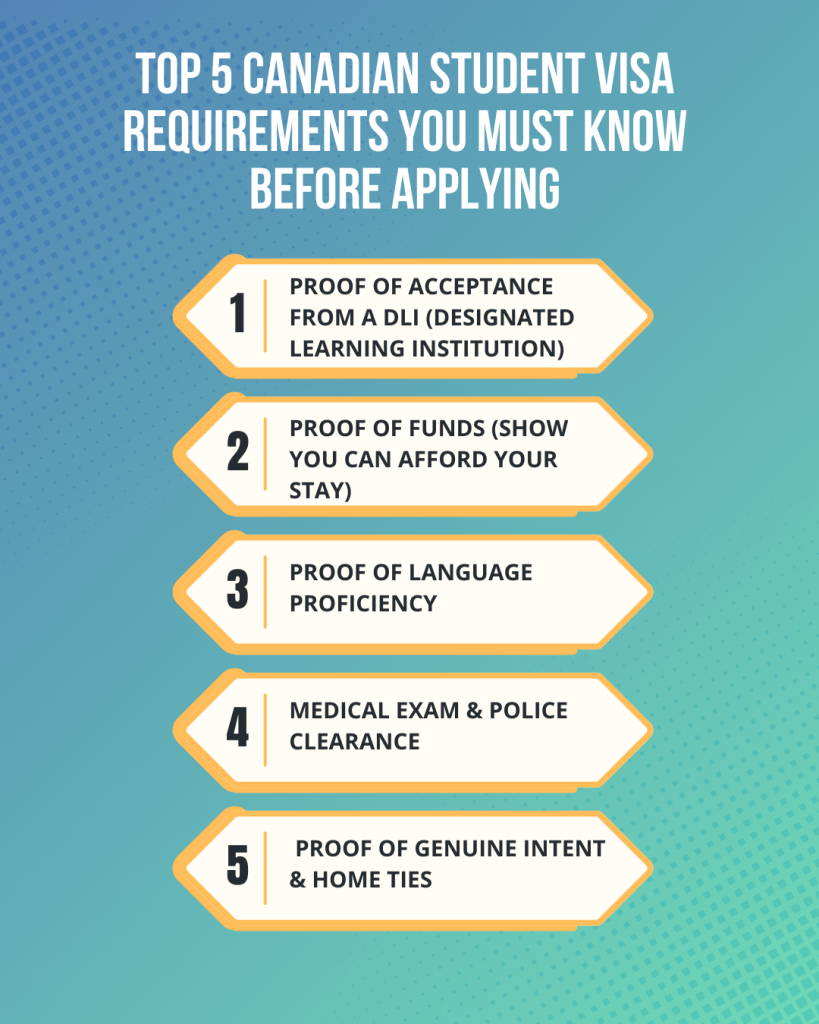
1️⃣ Proof of Acceptance from a DLI (Designated Learning Institution)
Before you think about visas, you need a seat in a Canadian classroom. And not just any school—only institutions on the official DLI list can admit international students. Once you receive your Letter of Acceptance (LOA), you’re ready to start your study permit journey.
👉 Your LOA should clearly mention your program, course duration, and start date. Most importantly, it must come from a registered DLI.
2️⃣ Proof of Funds (Show You Can Afford Your Stay)
Canada wants to ensure you are financially secure while studying. This means you must show you have enough money for:
- Your first year’s tuition fees
- Living expenses of at least $22,895 CAD (for one student, outside Quebec)
- Extra funds if you’re bringing a spouse or dependents
Acceptable financial proof includes:
✔️ Bank statements (4–6 months)
✔️ Paid tuition/housing receipts
✔️ A GIC (Guaranteed Investment Certificate) from a Canadian bank
✔️ Scholarship or sponsorship letters
3️⃣ Proof of Language Proficiency
Canada is bilingual (English & French), so you must prove you can study in one of these languages. For most students, English is a requirement.
Typically, undergrad programs need an IELTS 6.0 overall (no band below 5.5), while postgrad programs ask for 6.5 overall (no band below 6.0).
Accepted tests in 2025 include:
| ENGLISH | FRENCH |
| CELPIP: Canadian English Language Proficiency Index Program. You must take the CELPIP-General test. | TEF Canada: Test d’évaluation de français |
| IELTS: International English Language Testing System You must take the IELTS General Training option. We don’t accept IELTS One Skill Retake for Express Entry. | TCF Canada: Test de connaissance du français |
| PTE Core: Pearson Test of English You must take the PTE Core option. |
4️⃣ Medical Exam & Police Clearance
Canada takes student safety seriously. Depending on your country and program length, you may be asked to complete:
- Medical Exam with an IRCC-approved doctor
- Police Clearance Certificate to prove you have no criminal history.
5️⃣ Proof of Genuine Intent & Home Ties
This is the #1 reason many study permits are refused—visa officers doubt whether you’re truly coming to Canada to study. To overcome this, you need to clearly show that your purpose is education.
Strengthen your application with:
✔️ A strong Statement of Purpose (SOP)—explain your academic goals, why you chose Canada, and how the program connects to your career.
✔️ Evidence of ties to your home country (family, property, or a future job offer).
✔️ Consistency in your documents—any contradictions raise red flags.
✅ Final Thoughts
Applying for a Canadian study permit can feel overwhelming, but if you focus on these five essentials, you’re already halfway to success:
- A valid LOA from a DLI
- Proof of funds for tuition & living expenses
- Language proficiency results
- Medical & police clearance
- Strong proof of genuine study intent
Meeting these requirements not only improves your visa approval chances but also sets the foundation for a smooth academic journey in Canada.
🌍 Ready to start your Canadian dream? With the right guidance and preparation, you can make the process stress-free—and turn your acceptance letter into a life-changing opportunity.